Showing posts with label Zizal. Show all posts

Friday, May 17, 2019

Long Rowing

Assalamualaikum.


Long Rowing

This is a story of how I lead a kayaking race expedition to Bunga Mas 6. Our expedition were joined by 5 other kayaking members (all seniors), by which only 4 were racing using kayak, and the other 3 as judges on a laser boat.

It was an intense race, but alas, I won.

We awarded ourselves with pats in our backs for completing the very exhausting race. We then slowly paddled ourselves back to the jetty. Though it was exhausting beyond words, it is a pleasurable experience to engage in a common interest with some other very interesting seniors who had sailed the very seas for over 12 months. It was wonderful to hear their sailing stories (especially from the guy in blue).


That's it for this post. Thank you !

Thursday, February 21, 2019

Theodore Roosevelt - Leader I admire


Picture courtesy google.com

Theodore Roosevelt - The Embodiment Of the Strenuous Life
A New York governor who became the 26th U.S. president, Theodore Roosevelt is remembered for his foreign policy, corporate reforms and ecological preservation.
Courtesy of google.com

Synopsis

Born in New York City on October 27, 1858, Theodore "Teddy" Roosevelt was governor of New York before becoming U.S. vice president. At age 42, Teddy Roosevelt became the youngest man to assume the U.S. presidency after President William McKinley was assassinated in 1901. He won a second term in 1904. Known for his anti-monopoly policies and ecological conservationism, Roosevelt won the Nobel Peace Prize for his part in ending the Russo-Japanese War. He died in New York on January 6, 1919.

Early Life

Theodore Roosevelt Jr. was born on October 27, 1858, in New York City, to Theodore "Thee" Roosevelt Sr., of Dutch heritage, and Martha "Mittie" Bulloch, a Southern belle rumored to have been a prototype for the Gone with the Wind character Scarlett O'Hara. His family owned a successful plate-glass import business.
As a young boy, Theodore Roosevelt—or "Teedie," as he was known to his family members (he wasn't fond of the nickname "Teddy"), spent a lot of time inside his family's handsome brownstone, homeschooled due to his illnesses and asthma. This gave him the opportunity to nurse his passion for animal life, but by his teens, with the encouragement of his father, whom he revered, Theodore developed a rigorous physical routine that included weightlifting and boxing.
courtesy of google.com
When his father died during his second year at Harvard College, Roosevelt channeled his grief into working even harder: After graduating magna cum laude in 1880, he enrolled at Columbia Law School and got married to Alice Hathaway Lee of Massachusetts.

Political Life

Roosevelt didn't stay long at law school, opting instead to join the New York State Assembly as a representative from New York City—becoming the youngest to serve in that position. Not long after, Roosevelt was speeding through various public service positions, including captain of the National Guard and minority leader of the New York Assembly. However, the tragic deaths of his mother and his wife, which occurred on the same day (February 14, 1884), propelled Roosevelt to leave for the Dakota Territory for two years. There, he lived as a cowboy and cattle rancher, leaving his infant daughter in the care of his elder sister.
Returning to political life in 1886, Roosevelt was defeated for the New York City mayorship. Around the same time, he married his second wife, Edith Kermit Carow, whom he had known as a child (they had watched the funeral procession of Abraham Lincoln from a window in his grandfather's house on Union Square in New York City). Roosevelt soon resumed his career trajectory, first as a civil service commissioner, then as a New York City police commissioner and Assistant U.S. Navy Secretary under President William McKinley.
Taking a keen interest in the Spanish-American War, Roosevelt left his government post to organize a volunteer cavalry known as the Rough Riders, which he led in a bold charge up San Juan Hill in the Battle of San Juan Heights, in 1898. A war hero, and nominated for the Medal of Honor, Roosevelt was elected governor of New York in 1898.

U.S. Presidency

Roosevelt's progressive policies in New York ran him afoul of his own party, so Republican Party bosses plotted to quiet him by naming him on the McKinley ticket in the thankless post of vice president. However, after his re-election in 1901, President McKinley was assassinated. At age 42, Theodore "Teddy" Roosevelt became the youngest man to assume the U.S. presidency.
Theodore Roosevelt’s presidency is distinguished by his dedication to prosecuting monopolies under the Sherman Antitrust Act. Out of this commitment grew a benchmark of his first term, the "Square Deal"—a domestic program that embraced reform of the American workplace, government regulation of industry and consumer protection, with the overall aim of helping all classes of people. Roosevelt's charismatic personality and impassioned combination of pounding fists and emphatic rhetoric undoubtedly helped in pushing his agenda.
In 1905, Teddy Roosevelt walked his niece, Eleanor Roosevelt, down the aisle (Theodore's brother, Elliott, had died in 1894) during the wedding ceremony for Eleanor and her fifth cousin once removed, Franklin D. Roosevelt.
Around the same time, believing that America needed to take its rightful place on the world stage, Roosevelt initiated a massive public relations effort. Engaging his unofficial policy of “Speak softly and carry a big stick,” Roosevelt bulked up the U.S. Navy and created the "Great White Fleet," sending it on a world tour as a testament to U.S. military power. He also helped expedite completion of the Panama Canal by providing tacit approval of the Panama revolution with funds and a naval blockade preventing Columbian troops from landing in Panama. President Roosevelt was awarded the Nobel Peace Prize in 1906 for his role in negotiating the end of the Russo-Japanese War. Roosevelt believed that if Japan had devastated Russia, it would lead to an imbalance of power in the Pacific, one that the United States would eventually have to realign , but at a disastrous cost. 
Courtesy of google,com

Roosevelt's international  stance was the impetus for the Roosevelt Corollary to the Monroe Doctrine, which claims the right to intervene in cases of wrongdoing by a Latin American or any other nation, though some critics assert that the doctrine designates the United States as the "policeman" of the western world.
While it is true Theodore Roosevelt supported desegregation and women's suffrage, his administration took an often passive, sometimes contradictory approach to improving civil rights. He defended Minnie Cox, who experienced racial discrimination in the South while working as a postmaster, and strongly supported a woman’s right to vote in 1912. Roosevelt  was also the first president to entertain an African-American, Booker T. Washington, as a guest at the White House. However, the political backlash from the event was so severe that he never invited Washington back again.
One of Roosevelt’s less admirable actions regarding civil rights occurred in 1906. The War Department Inspector General had investigated an incident in Brownsville, Texas, involving black troops who had been accused of a shooting rampage that left one white person dead and another wounded. The Inspector General’s report recommended the president dismiss the solders because none would confess. Roosevelt waited until after the November elections—after hundreds of thousands of blacks cast their votes for Republican candidates across the North—and then dismissed all 167 black soldiers from the service. None would receive their pensions.    
Roosevelt has also been deemed the country's first environmentalist president. In 1906, he signed the National Monuments Act, protecting sites like the Grand Canyon and preserving countless wildlife sanctuaries, national forests and federal game reserves. He also made headway with the nation’s infrastructure, instigating 21 federal irrigation projects.
The presidential mansion officially became known as the White House when Roosevelt had the name emblazoned on his stationery. He hired the most illustrious architects of the time, McKim Mead and White, to renovate the decrepit mansion. During his presidential term, the White House served as a lively playground for the Roosevelts' six children; due in no small part to the president's passion for sports and books, each room of the home was enlivened with activity, from crawl space to library. "Giving the pony a ride in the elevator was but one of many stunts" of the (Theodore) Roosevelt White House, according to memoirs published in 1934 by Ike Hoover, the White House's chief usher.

Travel and Post-Presidency Politics

When Teddy Roosevelt left office in 1909, he felt assured that he was leaving the nation able hands; Roosevelt's successor was his friend, former Secretary of War William Howard Taft. Having enjoyed his travels in Europe and the Middle East with his family as a young boy, as well as his two years as a rancher in the Dakotas and countless hunting trips, it seems only logical that Roosevelt's next move would be embarking on an African safari.
But after two years of collecting specimens, speaking engagements and traveling—including as special ambassador to England for the funeral of King Edward VII—Roosevelt became disgruntled with Taft’s weak enforcement of progressive policies, and decided to make another run for the presidency. To do so, though, meant launching a third party initiative, as Taft was running on the Republican Party ticket. So Roosevelt formed the Progressive Party, also known as the "Bull Moose Party," and began campaigning for the 1912 election. While delivering a speech on the campaign trail in Milwaukee, Wisconsin, Roosevelt was shot in the chest in an assassination attempt by John Nepomuk Schrank. Shockingly, he continued his speech for 90 minutes before seeing a doctor, later chalking up the incident to the hazards of the business.
Roosevelt lost to Woodrow Wilson in the 1912 election, in a rather close popular vote. He considered running again in 1916, winning the Progressive nomination, but bowed out in favor of Republican Party nominee Charles Evans Hughes.
His political aspirations, however, would soon prove to be far from over. In 1914 when war broke out in Europe, Roosevelt became frustrated with Wilson’s stance on neutrality and continually criticized the president’s policy. When the U.S. finally declared war, Roosevelt requested permission to head a volunteer division for service in France in World War I, but Wilson had the Secretary of War turn him down.
Roosevelt was proud that all four of his sons enlisted for service during WWI, but brokenhearted when his youngest son, Quentin, was shot and killed in Germany.

Death and Legacy

When Teddy Roosevelt was a young boy, doctors discovered that he had a weak heart, and advised him to get a desk job and not strain himself. However, he lived a more active life than most. Outside of his political career, Roosevelt published more than 25 books about a range of subjects, including history, biology, geography and philosophy. He also published a biography and an autobiography, including The Winning of the West, comprised of four volumes.
Theodore Roosevelt died in his sleep on January 6, 1919, at his Long Island estate, Sagamore Hill, after suffering a coronary embolism. He was 60 years old. He was buried at the Youngs Memorial Cemetery in New York.
Although he was denied the Medal of Honor for the Battle of San Juan Heights, Roosevelt posthumously received the honor—the highest award for military service in the United States—more than 100 years later, on January 16, 2001, Roosevelt was the first president to receive the Medal of Honor, conferred by President Bill Clinton.
Teddy Roosevelt's energetic vision helped bring the nation into the new century. America owes nearly 200 million acres of national forest and parkland to his foresight—some of which can be viewed atop Mount Rushmore, where Roosevelt's visage is carved in memorial.
Courtesy of google.com
Hence concludes our biography of Teddy Roosevelt. 

Resources:
https://www.biography.com/people/theodore-roosevelt-9463424

Sunday, January 20, 2019

Organization - Meaning, Functions and It's Features

Organization - Meaning, Functions and It's Features

Definition

Organizing is the process of establishing orderly uses of all the organization's resources within the management system. Organization, on the other hand, is a group of people working together to accomplish a goal.

Need for Organization Management
  • Organization management gives a sense of security and oneness to the employees.
  • An effective management is required for better coordination among various departments.
  • Employees accomplish tasks within the stipulated time frame as a result of effective organization management.
  • Employees stay loyal towards their job and do not treat work as a burden.
  • Effective organization management leads to a peaceful and positive ambience at the workplace.


Types Of Organization

Organizations can be divided into 3 types:
  • Functional
  • Divisional
  • Matrix

For overall functions, the Functional types has been the most prevalent form of organization being implemented today for it's major pros over other types. Some advantages of Functional Organization are:
  • Suited to a stable environment
  • Fosters development of expertise
  • Offers colleagues for specialists
  • Requires little internal coordination
  • Requires fewer interpersonal skills


Committees

Committees are effective means of pooling the expertise of different members of an organization and channeling their efforts towards a common goal. Some common committees that are directly associated with the shipping industry are:
  • Shipboard Management Committee (SMC)
  • Shipboard Safety Committee

Essential Features of Organization Management

Planning
  • Prepare an effective business plan. It is essential to decide on the future course of action to avoid confusions later on.
  • Plan out how you intend to do things.
Organizing
  • Organizing refers to the judicious use of resources to achieve the best out of the employees.
  • Prepare a monthly budget for smooth cash flow.
Staffing
  • Poor organization management leads to unhappy employees who eventually create problems for themselves as well as the organization.
  • Recruit the right talent for the organization.
Leading
  • The managers or superiors must set clear targets for the team members.
  • A leader must make sure his team members work in unison towards a common objective. He is the one who decides what would be right in a particular situation.


Resources:

https://www.managementstudyguide.com/organization-management.htm


Friday, October 19, 2018

A Brief History Of Galleass

Image result for Galleas
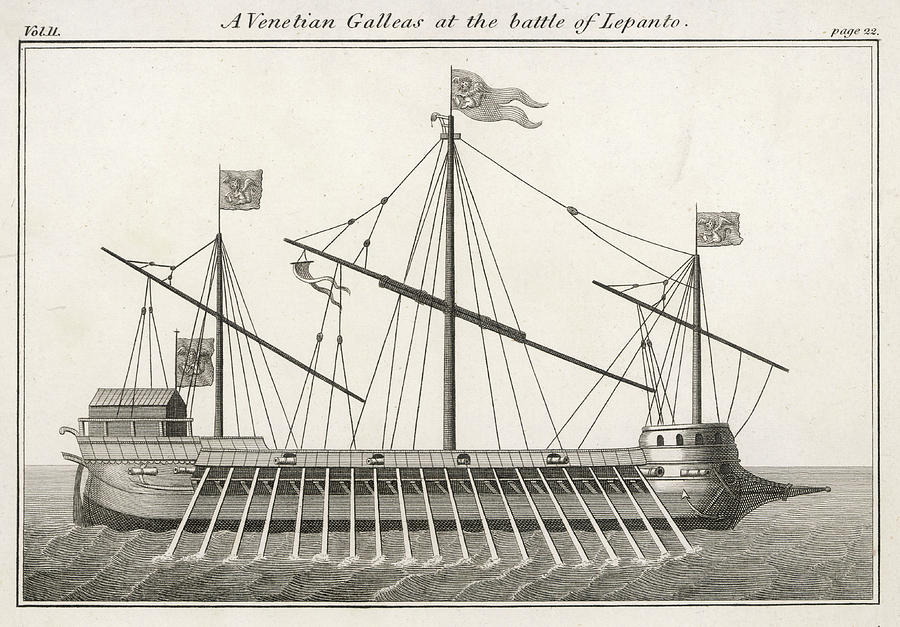
A Venetian Galleas at the battle of Lepanto


A Brief History Of Galleass

The coming of mighty men-of-war did not mean the immediate end of oared warships. In fact, some types of galleys and oared gunboats continued to serve well into the 19th century. Indeed, the Battle of Lepanto (1571), in which a combined European fleet defeated the Turkish fleet, differed little from traditional galley warfare with two exceptions. First, the scale of the action was very large, with more than 200 cannon-armed galleys on each side. Each of those galleys was propelled by 50 to 200 oarsmen and carried at least 50 additional men to fight and to man the guns and sails. Second, the European line of battle included six Venetian galleasses, a compromise type developed in the transition from oar to sail. These huge vessels, which depended on sail as well as oar, bristled with guns, including heavy ones in broadside. Although cumbersome to maneuver, their concentrated fire contributed importantly to victory.

Image result for Galleas
Galleass ala Vile
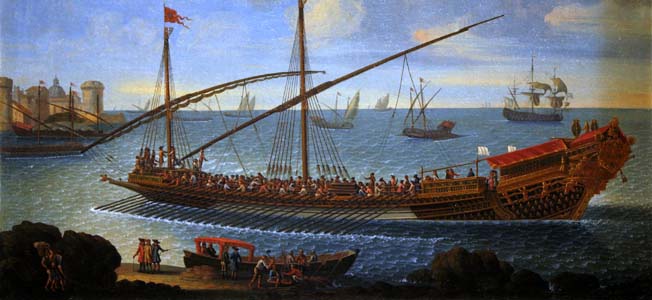
Galleasses outside the Mediterranean differed somewhat from Venice’s in that they were basically full-rigged sailing ships carrying broadsides of heavy guns and a bank of auxiliary oars for mobility. The hybrid existed only in small numbers and soon passed out of fashion to the north.
Image result for Galleas
Spanish design of galleass
White Bear 1564. Source Katipanti.net


A Brief History Of Privateer

A Brief History Of Privateer


Privateer, privately owned armed vessel commissioned by a belligerent state to attack enemy ships, usually vessels of commerce. Privateering was carried on by all nations from the earliest times until the 19th century. Crews were not paid by the commissioning government but were entitled to cruise for their own profit, with crew members receiving portions of the value of any cargo or shipping that they could wrest from the original owners. Frequently, it was impossible to restrain the activities of privateers within the legitimate bounds laid down in their commissions. Thus, it often became difficult to distinguish between privateers, pirates, corsairs, or buccaneers, many of whom sailed without genuine commissions.
Image result for francis drake
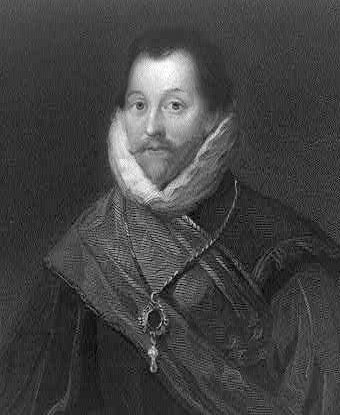
Portrait of Sir Francis Drake
In the late 16th century, English privateers such as Sir John Hawkins and Sir Francis Drake were encouraged or restrained, according to prevailing political conditions. With the growth of a regular navy, however, the British Admiralty began to discourage privateering because it was more popular among sailors than was serving in the navy. At this same period, Dutch Sea Beggars and French Huguenot privateers were active. Throughout the 17th century, English buccaneers in the West Indies, such as Sir Henry Morgan, sometimes sailed as genuine privateers. From 1690, French privateers from Dunkerque (Dunkirk) and Saint-Malo were particularly active against English commerce. During the American Revolution the American colonists found it difficult to form a new navy because more than 1,000 privateers were already licensed. The popularity of privateering continued in the War of 1812 between Great Britain and the United States when, for example, the U.S. brig Yankee alone seized or destroyed $5,000,000 worth of English property. France used many privateers during the French revolutionary and Napoleonic wars.
Image result for privateer history ship
Illustration of privateers during the Napoleonic wars
In 1856, by the Declaration of Paris, Great Britain and the other major European countries (except Spain) declared privateering illegal. The U.S. government refused to accede, holding that the small size of its navy made reliance on privateering necessary in time of war. The rise of the American navy at the end of the 19th century and the realization that privateering belonged to an earlier form of warfare prompted the United States to recognize the necessity of finally abolishing it. Spain agreed to the ban in 1908.
Commodore Walker's Action: the Privateer 'Boscawen' Engaging a Fleet of French Ships, 23 May 1745
Source: National Maritime Museum

At the Hague Peace Conference of 1907 it was then stipulated, and has since become part of international law, that armed merchant ships must be listed as warships, though there have been various interpretations of the word armed. The ambiguous status of the privateer has thus ceased to exist—the state now assumes full responsibility for all converted ships engaged in military operations.
Image result for privateer history ship

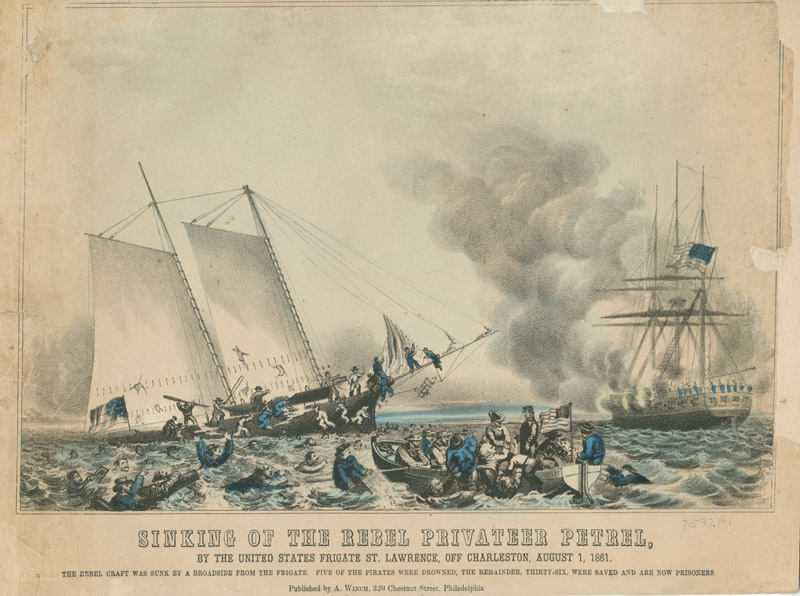
Sinking of the Rebel privateer Petrel, by the United States frigate St. Lawrence, off Charleston, August 1, 1861 (5532383440)

Ship Of The Line, Conqueror Of Great Britain


Image result for Ship of the line
James Guy Evans (United States, born England, circa 1810–1860) U.S.

Ship Of The Line, Conqueror Of Great Britain

Ship of the line, type of sailing warship that formed the backbone of the Western world’s great navies from the mid-17th century through the mid-19th century, when it gave way to the steam-powered battleship.
Image result for Ship of the line
Old portrait of the ship's stern view

The ship of the line evolved from the galleon, a three- or four-masted vessel that had a high superstructure on its stern and usually carried heavy guns along two decks. As fleets composed of these ships engaged in combat, they adopted a fighting formation called the line of battle, in which two opposing columns of ships maneuvered to fire their guns in broadside (a simultaneous discharge of all the guns arrayed on one side of a ship) against each other. Combat using these formations was known as line-of-battle warfare. Such battles were usually won by the heaviest ships carrying the biggest and most powerful guns. Therefore, a natural progression was toward fleets of big “line-of-battle ships,” or ships of the line.


Through the 17th century, the ship of the line acquired its definitive shape by settling on three masts and losing the ungainly superstructure aft. Lengths of 200 feet (60 metres) became common for such ships, which displaced 1,200 to 2,000 tons and had crews of 600 to 800 men. A ship of the line’s armament was arranged along three decks: the bottom-deck battery might consist of 30 cannons firing balls of 32 to 48 pounds; the middle-deck battery had as many guns firing balls of about 24 pounds; and the upper battery carried 30 or more 12-pounders.
Great Britain’s Royal Navy, which rated its sailing ships by the number of guns they carried, considered ships of the first through third rates—that is, ships carrying 60 or 70 to 100 or 110 guns—to be ships of the line. One of the most famous of these was HMS Victory, a 100-gun first-rater that served as the flagship of Horatio Nelson at the Battle of Trafalgar in 1805. (See Victory.)
Image result for Ship of the line
HMS Victory
The columnar formations that typified line-of-battle tactics were developed by the British in the late 17th century and came into standard use by most navies thereafter. In these tactics, each ship in the fleet followed in the wake of the ship ahead of it. The ships arrayed themselves one after the other at regular intervals of about 100 or more yards, for a distance that could stretch as long as 12 miles (19 km). This formation maximized the new firing power of the broadside and marked a final break with the tactics of galley warfare, in which individual ships sought each other out to engage in single combat by means of ramming, boarding, and so on. By maintaining the line throughout the battle, the fleet, despite obscuring clouds of smoke, could function as a unit under the control of the admiral. In the event of reverses, they could be extricated with a minimum of risk.

Image result for Ship of the line
Santa Ana Ship Of The Line

Resource:
https://www.britannica.com/technology/ship-of-the-line

Ibn Battuta, Greatest Explorer Of All Time

In this post we are going to delve into the life of Ibn Battuta, said to be the greatest explorer of all time.

Image result for ibn battuta
An illustration. Credit to History.com
Ibn Battuta, Greatest Explorer Of All Time

Born in Tangier, Morocco, Ibn Battuta came of age in a family of Islamic judges. In 1325, at age 21, he left his homeland for the Middle East. He intended to complete his hajj—the Muslim pilgrimage to the holy city of Mecca—but he also wished to study Islamic law along the way. “I set out alone,” he later remembered, “having neither fellow-traveler in whose companionship I might find cheer, nor caravan whose party I might join, but swayed by an overmastering impulse within me and a desire long-cherished in my bosom to visit these illustrious sanctuaries.”
Battuta began his journey riding solo on a donkey, but soon linked up with a pilgrim caravan as it snaked its way east across North Africa. The route was rugged and bandit infested, and the young traveler soon developed a fever so severe that he was forced to tie himself to his saddle to avoid collapsing. Nevertheless, he still found time during one stopover to wed a young woman—the first of some 10 wives he would eventually marry and then divorce during his travels.
In Egypt, Battuta studied Islamic law and toured Alexandria and the metropolis of Cairo, which he called “peerless in beauty and splendor.” He then continued on to Mecca, where he took part in the hajj. His travels might have ended there, but having completed his pilgrimage, he decided to continue wandering the Muslim world, or “Dar al-Islam.” Battuta claimed to be driven by a dream in which a large bird took him on its wing and “made a long flight towards the east…and left me there.” A holy man had interpreted the dream to mean that Battuta would roam across the earth, and the young Moroccan intended to fulfill the prophecy.
Ibn Battuta in Egypt. Illustration by Paul Dumouza. (Credit: Fine Art Images/Heritage Images/Getty Images)
Battuta’s next few years were a whirlwind of travel. He joined a caravan and toured Persia and Iraq, and later ventured north to what is now Azerbaijan. Following a sojourn in Mecca, he trekked across Yemen and made a sea voyage to the Horn of Africa. From there, he visited the Somali city of Mogadishu before dipping below the equator and exploring the coasts of Kenya and Tanzania.
Upon leaving Africa, Battuta hatched a plan to travel to India, where he hoped to secure a lucrative post as a “qadi,” or Islamic judge. He followed a winding route east, first cutting through Egypt and Syria before sailing for Turkey. As he always did in Muslim-controlled lands, he relied on his status as an Islamic scholar to win hospitality from locals. At many points in his travels, he was showered with gifts of fine clothes, horses and even concubines and slaves.
Ibn Battuta, Moroccan explorer, in Egypt. Illustration by Leon Benett from book by Jules Verne, 1878. (Credit: Lanmas/Alamy Stock Photo)
From Turkey, Battuta crossed the Black Sea and entered the domain of a Golden Horde Khan known as Uzbeg. He was welcomed at Uzbeg’s court, and later accompanied one of the Khan’s wives to Constantinople. Battuta stayed in the Byzantine city for a month, visiting the Hagia Sophia and even receiving a brief audience with the emperor. Having never ventured to a large non-Muslim city, he was stunned by the “almost innumerable” collection of Christian churches within its walls.
Battuta next traveled east across the Eurasian steppe before entering India via Afghanistan and the Hindu Kush. Arriving in the city of Delhi in 1334, he won employment as a judge under Muhammad Tughluq, a powerful Islamic sultan. Battuta passed several years in the cushy job and even married and fathered children, but he eventually grew wary of the mercurial sultan, who was known to maim and kill his enemies—sometimes by tossing them to elephants with swords attached to their tusks. A chance to escape finally presented itself in 1341, when the sultan selected Battuta as his envoy to the Mongol court of China. Still thirsty for adventure, the Moroccan set out at the head of a large caravan brimming with gifts and slaves.


The trip to the Orient would prove to be the most harrowing chapter of Battuta’s odyssey. Hindu rebels harassed his group during their journey to the Indian coast, and Battuta was later kidnapped and robbed of everything but his pants. He managed to make it to the port of Calicut, but on the eve of an ocean voyage, his ships blew out to sea in a storm and sank, killing many in his party.
The string of disasters left Battuta stranded and disgraced. He was loath to return to Delhi and face the sultan, however, so he elected to make a sea voyage south to the Indian Ocean archipelago of the Maldives. He remained in the idyllic islands for the next year, gorging on coconuts, taking several wives and once again serving as an Islamic judge. Battuta might have stayed in the Maldives even longer, but following a falling out with its rulers, he resumed his journey to China. After making a stopover in Sri Lanka, he rode merchant vessels through Southeast Asia. In 1345, four years after first leaving India, he arrived at the bustling Chinese port of Quanzhou.
Battuta described Mongol China as “the safest and best country for the traveler” and praised its natural beauty, but he also branded its inhabitants “pagans” and “infidels.” Distressed by the unfamiliar customs on display, the pious traveler stuck close to the country’s Muslim communities and offered only vague accounts of metropolises such as Hangzhou, which he called “the biggest city I have seen on the face of the earth.” Historians still debate just how far he went, but he claimed to have roamed as far north as Beijing and crossed through the famous Grand Canal.
China marked the beginning of the end of Battuta’s travels. Having reached the edge of the known world, he finally turned around and journeyed home to Morocco, arriving back in Tangier in 1349. Both of Battuta’s parents had died by then, so he only remained for a short while before making a jaunt to Spain. He then embarked on a multi-year excursion across the Sahara to the Mali Empire, where he visited Timbuktu.
Battuta had never kept journals during his adventures, but when he returned to Morocco for good in 1354, the country’s sultan ordered him to compile a travelogue. He spent the next year dictating his story to a writer named Ibn Juzayy. The result was an oral history called A Gift to Those Who Contemplate the Wonders of Cities and the Marvels of Traveling, better known as the Rihla (or “travels”). Though not particularly popular in its day, the book now stands as one of the most vivid and wide-ranging accounts of the 14th century Islamic world.
Following the completion of the Rihla, Ibn Battuta all but vanished from the historical record. He is believed to have worked as a judge in Morocco and died sometime around 1368, but little else is known about him. It appears that after a lifetime spent on the road, the great wanderer was finally content to stay in one place.
Image result for rehla ibn battuta cover
A translated version of Rehla Ibn Battuta, The Adventures Of Ibn Battuta by Ross E. Dudd.
Reference:
https://www.history.com/news/why-arab-scholar-ibn-battuta-is-the-greatest-explorer-of-all-time

Warriors Of Carthage, Quinquereme

Warriors Of Carthage, Quinquereme


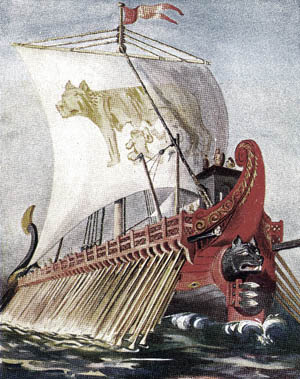
Image result for Quinquereme
Quinquereme of The Carthage and Roman Navy. Warfarehistorynetwork.com

The third century BC saw fierce naval competition arise all across the Mediterranean. In the west, the Romans and Carthaginians struggled for control of the sea. In the eastern Mediterranean, the Hellenistic Successor kingdoms of Alexander the Great’s world empire engaged in a costly naval race, each trying to outdo the other by building the biggest ships.
Both the Romans and the Carthaginians had settled upon the quinquereme, or “five,” as their standard warship. It presented, for its day, a good combination of speed, power, and maneuverability in battle. Among the Hellenistic states, however, new and sometimes extraordinary types of warships appeared.

The Quinquereme, Trireme & Hexere

Offering a balance between speed, maneuverability and power, both the Carthaginian & Roman Navy adopted the quinquereme as its standard vessel.
Quinquereme is a unique rendition of the traditional
trireme of it's time
The trireme, or trieres, in Greek, had long since been superseded in the Greek world by the tetreres (four) and the penteres (five). Alexander had larger vessels, such as the hexeres, or “six,” built just before he died for his planned invasion of Arabia. Even Alexander’s fleet, however, represented only a conservative increase in overall ship size in comparison to the monster galleys constructed by several of his Successors.
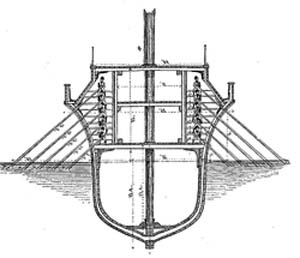
Various Successor kings constructed sevens, eights, nines, tens, elevens, twelves, fifteens, sixteens, and even thirties and at least one forty. Working out the oaring systems of the better-attested types of war galley in the ancient world is a difficult task. Doing so for these much larger vessels is nearly impossible. For the sixes and sevens, and probably the eights and nines, it is likely that extra rowers were added at one or more of the three levels of oars. As more rowers were added, the ships would have had to become a little wider in the beam to accommodate the extra crew. The much larger galleys would have required even more rowers and likely much greater expenditure to construct.

Larger and Larger War Galleys

Image result for carthage dido
Dido I, Queen Of Carthage, ruled the kingdom during
it's golden age.
What could explain the enthusiasm for ever-larger war galleys on the part of the Successors, as opposed to the more sober Roman and Carthaginian constructions policies? High cost and the strains of war may have caused the Romans and Carthaginians to focus on building galley types that they knew would be of use in battle. The quinquereme was a tried and tested design. Ships built much larger than the quinquereme probably offered little in the way of a real tactical advantage. Further, they would have called for even larger numbers of rowers to crew them, a factor not to be overlooked when even one quinquereme needed some 300 men to row. Rome was oftentimes short of trained rowers, and the Carthaginians were not a numerous people to begin with, so both sides may have shied away from such larger, more manpower-hungry types.
The Successor kings, on the other hand, were engaged in a competition for international prestige and influence as well as purely military advantage. Perhaps having the biggest ships was as much a means of impressing the rest of the Hellenistic Greek world as it was of inflicting harm on one’s enemies. Demetrius the Besieger (337-283 BC), for instance, is known to have equipped his extensive fleet with fifteens and sixteens and he had at least one thirteen aboard which he entertained guests. Lysimachus of Thessaly (c.355-281 BC), answered Demetrius with the Leontophoros, a superheavy galley capable of carrying 1,200 fighting men on its deck in addition to the rowers and other crewmen. Later on, Demetrius’s son, Antigonus Gonatas, outdid Lysimachus with an even larger vessel.

The Naval Race Continues

Both the Romans and the Carthaginians had settled upon the quinquereme, or “five,” as their standard warship.
architecture of the Quinquereme
Later generations kept up the naval race. King Ptolemy II of Egypt (309-246 BC) gathered together a navy of 17 fives, five sixes, 37 sevens, 30 nines, 14 elevens, two twelves, four thirteens, one twenty, and three thirties. Ptolemy IV (221- 204 BC) added to the contest with the introduction of the superlative “forty.” This vessel was enormous even by the gargantuan standards of the age and its shape is still subject to scholarly debate. Its full complement of rowers, sailors, and marines is said to have numbered around 7,000 men, which is comparable to the crew of a modern aircraft carrier.
The naval race among Alexander’s Successors, much like the Successors themselves, was extravagant, showy, and deeply competitive. In the end, though, the grand fleets of the East, like their armies, would be unable to prevent the region from eventually falling under the domination of the rising power of Rome.
Resource:
https://warfarehistorynetwork.com/daily/military-history/the-quinquereme-in-the-carthaginian-roman-navy/

Long Rowing

Assalamualaikum. Long Rowing This is a story of how I lead a kayaking race expedition to Bunga Mas 6. Our expedition were joined by ...